The government’s plan to implement the Zero Over Dimension Over Load (ODOL) policy in 2027 has received support from logistics industry players. However, its implementation is considered to require a careful and gradual approach to avoid triggering a surge in national logistics costs. Advisory Board Member of The Chartered Institute of Logistics and Transport, Yukki Nugrahawan Hanafi, emphasized that the logistics sector fundamentally supports the policy, particularly from a transportation safety perspective. “Logistics business players essentially support the implementation of ODOL as it prioritizes safety and security in transportation,” Yukki told Kompas.com on Tuesday (April 14, 2026).
Nevertheless, Yukki cautioned that a sudden implementation could significantly increase logistics costs. “This policy needs to be implemented gradually to prevent a sudden spike in logistics costs,” he explained.
He added that varying levels of readiness among business players across regions must also be a key consideration for the government. “The readiness of business players is uneven, so the approach cannot be uniform,” he said. In addition to business readiness, infrastructure conditions are seen as a crucial factor in supporting the success of the Zero ODOL policy. “Infrastructure readiness, particularly road quality and capacity, still needs improvement,” Yukki noted. According to him, road improvements, increased capacity, and the standardization of road classes across regions must be accelerated to ensure smooth logistics distribution.
He also highlighted the heavy reliance of Indonesia’s logistics system on land transportation. “This is important to avoid congestion, cargo accumulation, and delays that could ultimately drive up logistics costs,” he said. “Nearly 90 percent of national logistics movement still depends on road transportation, making this aspect highly strategic,” he added.
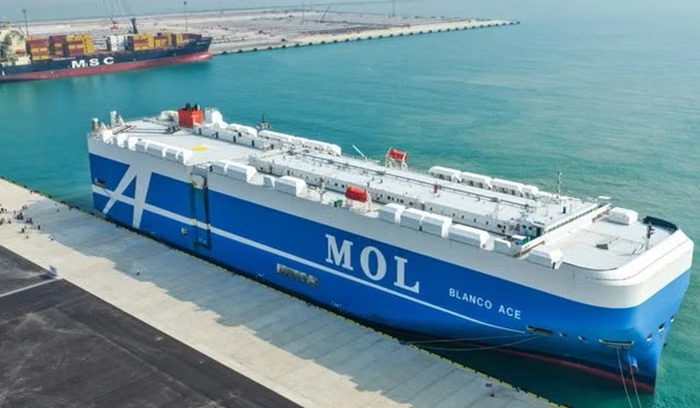
To anticipate the impact of the ODOL policy, Yukki encouraged the government to accelerate the development of a multimodal logistics system. In addition, sea and air transportation must also be strengthened to support distribution efficiency. “The use of rail transport needs to be optimized as an alternative distribution mode,” he said. “The role of Ro-Ro vessels and air cargo must also be prepared to anticipate future increases in logistics demand,” he continued.
Despite the challenges, the ODOL policy is also seen as an opportunity to improve the national logistics ecosystem. Some of the innovations include optimizing digital-based route planning and load consolidation. “This policy could encourage a shift toward multimodal systems and enhance operational innovation among business players,” Yukki explained. “It has the potential to improve fleet management, reduce accident risks, and lower maintenance costs caused by overloading,” he concluded.
—
Previously, Director General of Land Transportation, Aan Suhanan, confirmed that his office is strengthening strategies to address over-dimension and overloading violations through enhanced monitoring systems. He emphasized the importance of comprehensive digital transformation in logistics transport supervision to enable faster and more effective detection of ODOL violations.
“Currently, supervision is still partial and conventional. Our personnel are limited and must monitor a large number of overloaded and over-dimension vehicles. This means we need to implement technology- and data-based digital monitoring, as manual methods are no longer sufficient. We will maximize the use of data available across ministries and agencies,” Aan explained in Jakarta on Monday (April 13, 2026).
Aan stated that the transformation involves the use of technologies such as ETLE cameras and Weigh in Motion (WIM) systems to facilitate monitoring processes and law enforcement against ODOL violations. He added that the transformation also aims to ensure that responsibility for violations is not solely placed on drivers.
“With technology-based monitoring, cargo owners and transport operators can also be held accountable for ODOL violations,” Aan said. “In the past, drivers were often made scapegoats, even though cargo owners or vehicle owners should be aware of safety and avoid overloading. With the system we are building, responsibility will not only fall on drivers, but also on operators and business owners,” he asserted.
The original article was published at Kompas.com and can be accessed here