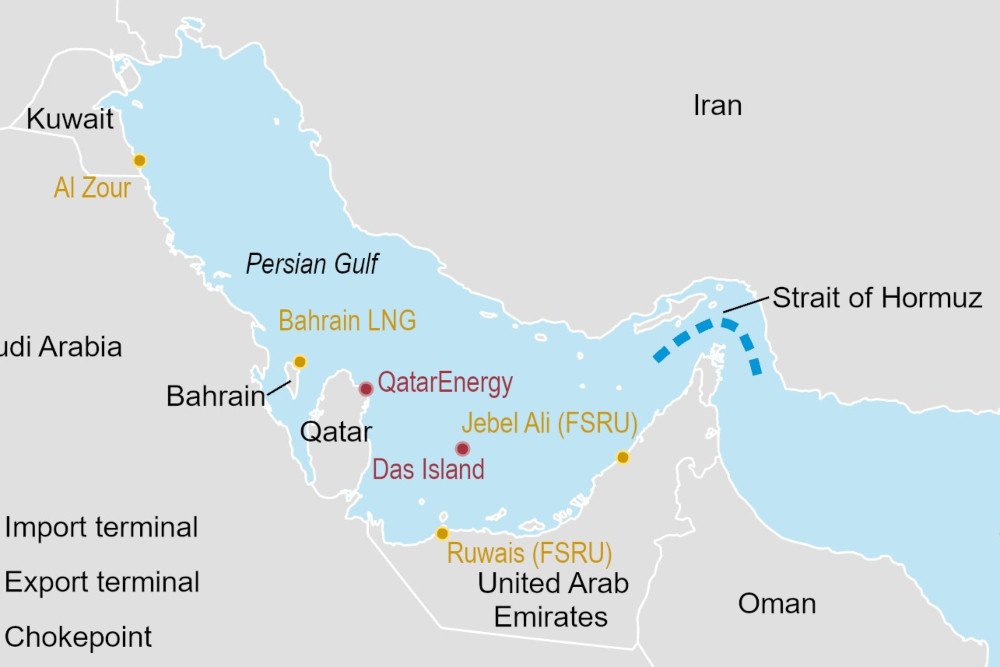
The Indonesian Logistics and Forwarders Association Institute (ALFI Institute) has warned that the escalation of the Israel-Iran geopolitical conflict could drive up international logistics costs. The conflict could intensify if a blockade of the Strait of Hormuz—one of the main oil and gas distribution routes from the Middle East to the Asia-Pacific—is implemented.
Chairman of the ALFI Institute, Yukki Nugrahawan Hanafi, emphasized that businesses in the transportation and supply chain logistics sector are closely monitoring the potential escalation if a blockade occurs in the Strait of Hormuz, a critical artery for global energy distribution.
“International and national logistics businesses are currently calculating the risks of operating through waters near the Strait of Hormuz. With these risk mitigation measures, access to and availability of logistics through this region could decrease, disrupting global supply chains,” he said.
For context, the Strait of Hormuz is a strategic point in global energy distribution. According to the International Energy Agency (IEA), an average of 20 million barrels of crude oil per day—equivalent to 30% of total global trade—passes through this strait. Liquefied natural gas (LNG) shipments via the Strait of Hormuz also account for 20% of global trade.
Yukki added that, in addition to businesses avoiding these waters, a blockade-driven rise in energy commodity prices would further increase logistics costs, potentially impacting import-export shipments and the competitiveness of Indonesian products. There are also concerns that a blockade in the Strait of Hormuz could trigger additional disruptions in the Red Sea.
“If Iran implements a blockade of the Strait of Hormuz as retaliation against Israel, the rise in logistics costs will not only be driven by rerouted trade flows but also by higher operational costs due to rising energy prices, particularly crude oil. Amid a slowdown in global demand caused by the 2025 trade wars, higher logistics costs would place additional pressure on import-export businesses,” Yukki explained.
Reflecting on the Red Sea conflict between late 2023 and early 2024, businesses faced higher shipping costs and longer transit times.
“National businesses must remain vigilant and proactive regarding rising logistics costs, particularly if the Israel-Iran conflict escalates further and spills over into other major trade routes such as the Red Sea. In addition, the national supply chain could be disrupted as businesses adjust operations to overcome logistics obstacles,” concluded Yukki.
—
The article has been published and can be accessed here