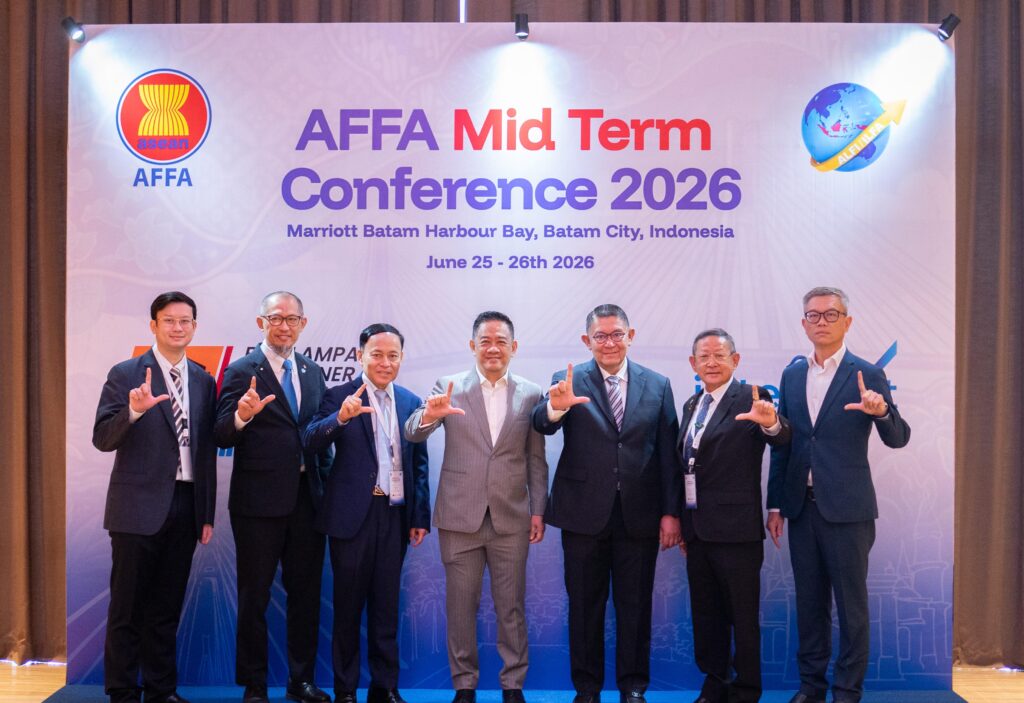
Batam, 26 June 2026 – The ASEAN Federation of Freight Forwarders Associations (AFFA) held its 2026 Council Mid-Year Meeting on 25–26 June 2026 at the Marriott Hotel Harbour Bay, Batam. Hosted by the Indonesian Logistics and Forwarders Association (ALFI) in collaboration with AFFA, the meeting carried the theme “Strengthening ASEAN Logistics Connectivity through Trade Facilitation, Digitalization, Security, and Capacity Development.” The forum brought together representatives from the ten AFFA member associations across ASEAN, along with Indonesia’s national logistics stakeholders.
The meeting took place amid a major transformation of Southeast Asia’s logistics sector, driven by growing intra-ASEAN trade, global manufacturing diversification, e-commerce expansion, and increasing demand for resilient and sustainable supply chains. ASEAN’s freight and logistics market is estimated to be worth approximately US$288 billion in 2025 and is projected to reach US$390 billion by 2030, with Indonesia expected to remain the region’s largest contributor.
Chairman of the Indonesian Logistics and Forwarders Association (ALFI), M. Akbar Djohan, said the forum comes at a highly opportune moment. “Logistics connectivity is the lifeblood of ASEAN’s economic integration. Amid geopolitical uncertainty and the shifting global supply chain landscape, our region must strengthen collaboration to remain competitive. This forum provides a platform for industry stakeholders to align their efforts and formulate a common position,” said Akbar.
Echoing Akbar’s remarks, Yukki Nugrahawan Hanafi, Senior Vice President of the International Federation of Freight Forwarders Associations (FIATA) and Chairman of the Advisory Council of the ASEAN Federation of Freight Forwarders Associations (AFFA), said that selecting Batam as the host city carries significant strategic meaning.
“Batam is a tangible example of how port connectivity, trade facilitation, digital transformation, and logistics infrastructure can enhance regional competitiveness. Choosing Batam as the host city reaffirms our commitment to developing emerging logistics hubs that contribute to ASEAN’s economic integration,” said Yukki.
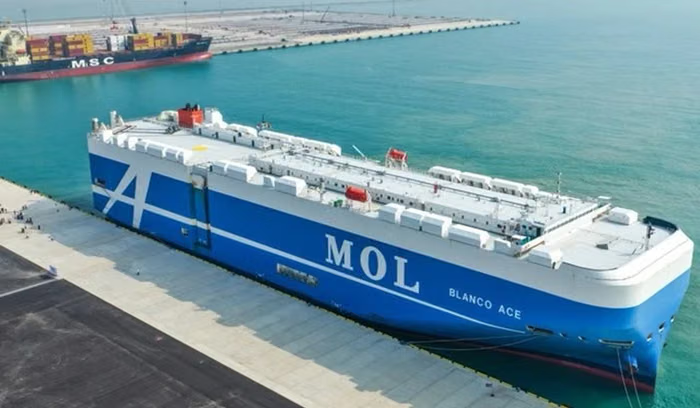
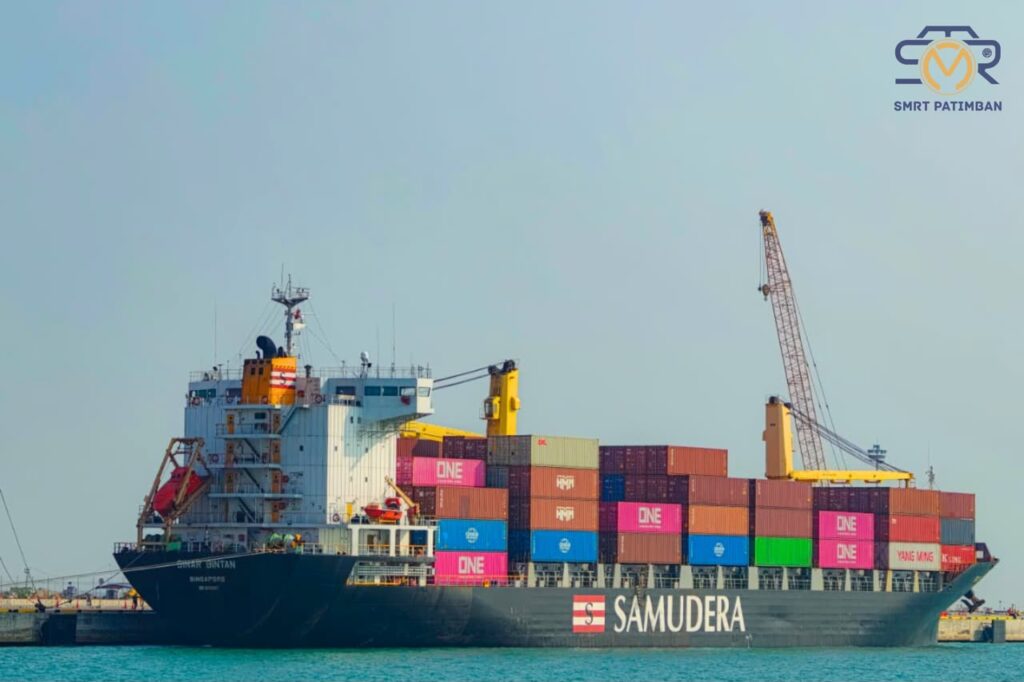
Strategically located along the Strait of Malacca—one of the world’s busiest shipping lanes—Batam occupies a vital position in global trade. Throughout 2025, more than 102,500 vessels transited the strait, up from approximately 94,300 vessels in 2024, with the waterway handling around one-quarter of global traded goods. As a Special Economic Zone (SEZ) and Free Trade Zone (FTZ) situated adjacent to Singapore, Batam serves as a maritime gateway connecting Indonesia with the region and the global economy.
The AFFA Mid-Year Meeting will focus on three strategic pillars. The Trade Facilitation pillar will discuss the implementation of the ASEAN Single Window, customs modernization, multimodal transportation, and MSME participation in regional trade. The Security and Digitalization pillar will address digital freight forwarding, the Electronic Bill of Lading (eBL), cybersecurity, as well as supply chain visibility and resilience. The Capacity Development pillar will emphasize human capital development, professional certification, and the participation of women and young professionals in the logistics sector.
In addition, the meeting features three key Working Groups: the AFFA Logistics Institute (ALI), the Trade Facilitation Working Group, and the Sustainability and Digitalization Working Group.
Yukki emphasized that these three strategic pillars and working groups are closely interconnected and inseparable from the needs of businesses operating within global supply chains.
“Efficient trade facilitation must be supported by secure digital systems and a competent workforce. Logistics efficiency extends beyond physical infrastructure to encompass governance, technology, and investment in education, skills development, and talent capacity aligned with industry needs. These are the foundations upon which a resilient and adaptive ASEAN supply chain is built, enabling deeper integration into global supply chains,” Yukki stated.
The meeting is expected to deliver several concrete outcomes, including the AFFA Strategic Priorities 2026–2027, ASEAN trade facilitation policy recommendations, recommendations on supply chain security and digitalization, and a regional capacity development roadmap. The agenda also includes country updates, technical presentations, roundtable discussions, and the adoption of resolutions and recommendations. In addition, Timor-Leste’s accession to AFFA remains under the membership process.
Chairman of the ASEAN Federation of Freight Forwarders Associations (AFFA), Chalermsak Karnchanawarin, concluded by reaffirming Southeast Asia’s strategic role in an increasingly dynamic global supply chain landscape.
“The Strait of Malacca reminds us that ASEAN sits at the heart of global trade. Our responsibility is to ensure that this strategic position translates into tangible benefits through faster and more efficient cargo flows, competitive logistics costs, and a sustainable regional economy. From Batam, we strengthen that foundation together,” Chalermsak concluded.
—
The original article can be accessed here at Detik.com